
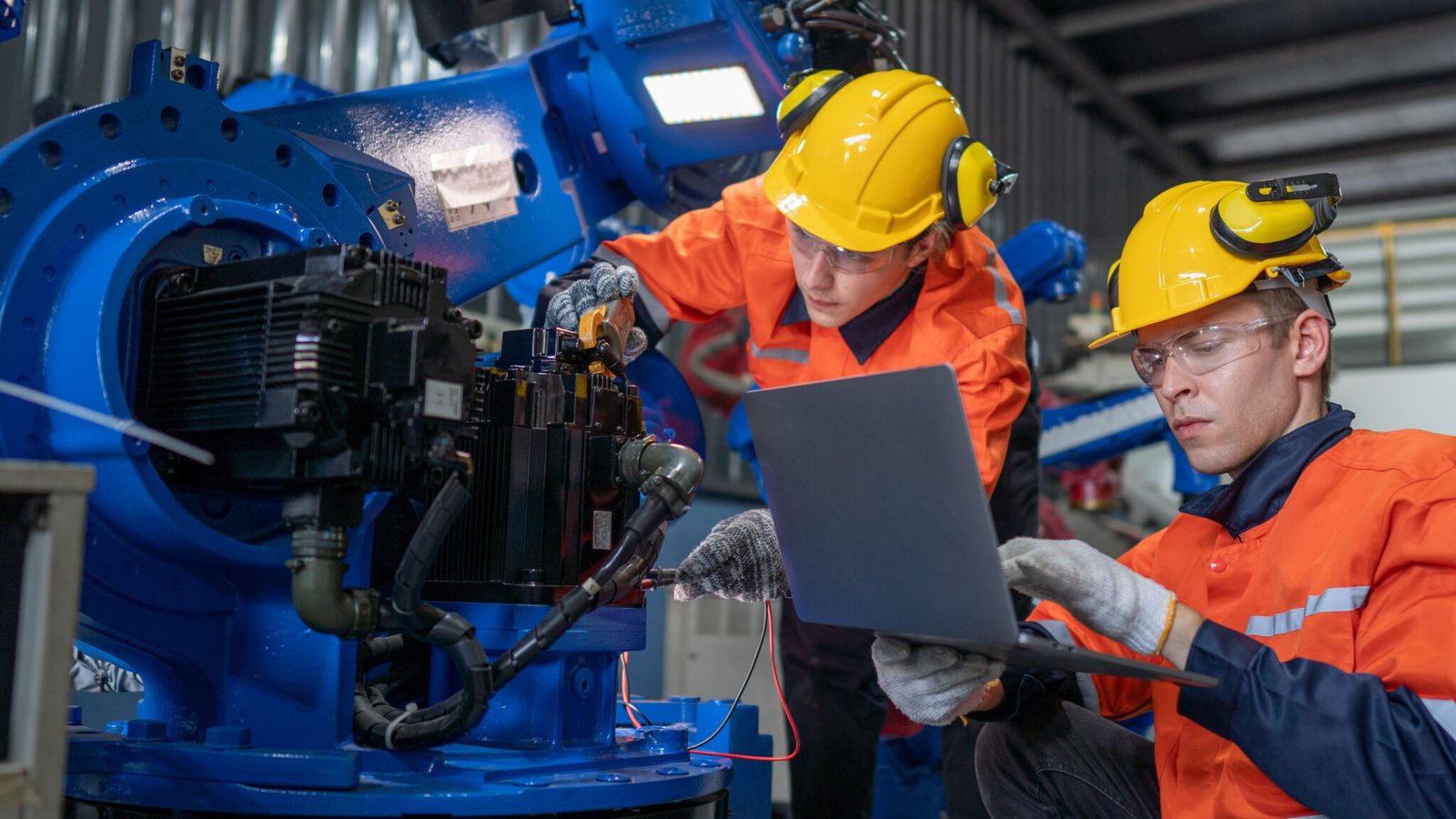

Servo Motor Repair for Robots and CNC Machines

We diagnose and repair servo motors, amplifiers, and encoders for FANUC, Yaskawa, Mitsubishi, ABB, KUKA, Baldor, Kollmorgen, and Siemens equipment on down machines and idle robots.

Signs Your Servo Motor Is Failing

A failing servo motor rarely fails without warning. Watch for unusual noise or vibration at the motor housing, a hot motor case, nuisance overload trips, intermittent stalls, or a machine that loses position mid-cycle. FANUC systems commonly show SV or SRVO alarms in the 400-460 range: SRVO-401 VRDY OFF points to an amplifier-ready signal drop; SV0301 is an APC absolute encoder communication error; SV0381 flags an encoder-phase abnormality on an external linear scale; SV0400 is motor or amplifier overtemperature; SV0411 is excessive position error; SV0438 is excessive motor current. Yaskawa Sigma-series drives report A.81/A.83 for encoder battery loss, A.82/A.84 for encoder memory errors, A.85 for encoder overspeed at power-on, and A.86 for encoder overtemperature. Mitsubishi MR-J amplifiers report ER.50 for overload. Siemens SINAMICS drives report F7900/207900 for sustained torque-limit operation and alarm 2102 for NCK battery undervoltage. Operators typically notice the axis faulting on startup, the robot losing mastering, or the machine stopping partway through a cycle.

Robot Power Supply Repair & PSU Restoration

How We Repair and Rebuild Servo Motors

Repair starts with the exact alarm text and alarm history, not a parts swap. We check incoming power, the emergency-stop chain, connectors, motor and encoder cables, cooling, lubrication, and mechanical load before condemning a motor or amplifier, since cable damage and mechanical binding produce the same symptoms as electrical failure. Motor-level work can include disassembly, bearing and seal replacement, resolver or encoder replacement, winding and insulation testing, rotor and shaft inspection, brake inspection, connector repair, cleaning, and reassembly, depending on the design and test results. Amplifier-level work can include replacing failed power semiconductors, DC-bus capacitors, gate-drive components, relays, contactors, fuses, cooling fans, and control-board components, followed by calibration or parameter verification. Encoder repair requires confirming the feedback technology first: absolute or incremental, serial or analog signaling, resolver, battery-backed memory, and communication protocol, because physically similar encoders are not always electrically interchangeable.

Models and part families we repair:

  • FANUC αi and βi series AC servo motors with SVM and SVPM amplifiers
  • Yaskawa Sigma-II, Sigma-5, and Sigma-7 servomotors and SERVOPACKs
  • Mitsubishi MR-J2, MR-J3, and MR-J4 servo amplifiers and matched motors
  • Siemens SINAMICS servo drives and motors
  • ABB robot servo motors and drive modules
  • KUKA robot axis motors and controllers
  • Baldor servo motors and drives, including Baldor/ABB product lines
  • Kollmorgen motion system motors and drives

Testing and Verification Before Return

Before a motor leaves the shop we run static checks: insulation resistance, phase-to-phase resistance balance, winding-to-frame insulation, brake resistance and release operation, shaft runout, bearing condition, encoder feedback, and thermal-sensor continuity. Dynamic testing follows: no-load rotation, direction and speed verification, current or torque observation, brake cycling where fitted, feedback or commutation verification, vibration and noise checks, temperature monitoring, and hipot testing where appropriate. Where a load test or dynamometer is used, we verify torque, speed, current, heating, direction, feedback stability, and vibration against the motor’s rated data. Repaired amplifiers are tested with matched motor and feedback equipment for power-up behavior, fault detection, command response, current regulation, speed or position response, regenerative operation where applicable, and protective functions. Burn-in is a controlled extended run intended to expose intermittent thermal, vibration, connection, or electronic failures that a short bench test can miss; duration, load, and pass criteria are recorded. The repair report documents as-received condition, symptoms, failed components, measurements, parts replaced, and final test conditions.

Rebuilding and Replacing Robot Power Supply Units
Benefits of Timely Robot Power Supply Repairs​

Preventing Servo Failures

Preventive maintenance reduces unplanned servo failures. Check cabinet cooling and filters regularly, since a blocked filter or failed fan raises motor and amplifier temperature and shortens the life of power electronics, capacitors, insulation, and encoder electronics. Inspect motor and encoder cables for flexing or abrasion, tighten and clean connectors, verify grounding and shielding, and check lubrication and mechanical alignment. Replace absolute-encoder batteries on the schedule the equipment manufacturer specifies; a lost battery can erase position data and force re-mastering or parameter recovery on a robot or CNC axis. Trend a few early indicators before they become downtime: rising motor case temperature, an increasing rate of overload trips, growing position error on a given axis, and encoder battery or memory alarms. Before replacing a motor for repeated overload alarms, rule out mechanical causes: guideway friction, ballscrew damage, misalignment, lubrication failure, collision damage, brake drag, or a tooling or payload change that increased torque demand.

Repair vs Replacement Decision

A servo failure that stops production is expensive by the hour, which makes the repair-versus-replace decision mostly about lead time and part availability. New-unit lead times vary widely by manufacturer, series, options, and whether exchange stock exists; a repair estimate should separate diagnostic time, parts-procurement time, repair time, testing time, and return shipping rather than promise one turnaround for every job. Obsolete models add another factor: the original OEM motor or amplifier may be discontinued or available only as an expensive exchange unit. Repairing or remanufacturing the existing motor, amplifier, or encoder preserves the mechanical and electrical interface already installed on the machine, but compatibility still has to be confirmed from exact part numbers and application data, not the brand name alone. For many maintenance departments, a repaired unit returned with test data gets the line running again without a redesign of mounting, wiring, or control parameters.

Why Choose Robotics Integration

Robotics Integration works on servo motors, amplifiers, and encoders across FANUC, Yaskawa, Mitsubishi, ABB, KUKA, Baldor, Kollmorgen, and Siemens equipment, covering both CNC machine axes and robot axes. Work is offered as repair-and-return service and as on-site support for troubleshooting and installation. Searching servo motor repair near me finds a location, but it does not by itself confirm that a shop can support your exact brand and model family, repair the feedback device fitted to your motor, or provide documented test results; that has to be verified case by case. Quoting starts with the nameplate and label data from the motor, amplifier, or encoder, the alarm code or symptom description, and photos of the unit and connectors. Because compatible-looking units can differ in voltage, torque rating, feedback type, brake configuration, and connectorization, we confirm the exact part numbers before quoting a repair or a substitute.

Request a Servo Motor Repair Quote

To get a servo motor repair quote, send the complete nameplate data from the motor, amplifier, or encoder: manufacturer, model number, and part number, including any option or suffix codes. Include the alarm code or a description of the symptom, such as an overload trip, a lost position, an encoder fault, or a motor that will not turn. Photos of the nameplate, connectors, and any visible damage help narrow the diagnosis before the unit ships. This applies to FANUC, Yaskawa, Mitsubishi, ABB, KUKA, Baldor, Kollmorgen, and Siemens motors, amplifiers, and encoders, on robots and CNC machines alike. Call 1-602-449-1556 to discuss a down unit or a failing axis and to start a repair quote.

Talk A Robotics Integrator

By submitting this form, you agree to receive communications via phone, text message, and email. Message and data rates may apply. Your information may be shared with trusted third-party service providers solely for the purpose of helping you explore Section Robotic Intergration options. You also agree to our Privacy Policy and Terms of Service.

Success Stories: See What Business Have To Say About Robotics Integration

4.7 Customer Reviews
Business Satisfaction: 98% Delighted with Their Robotics Integration