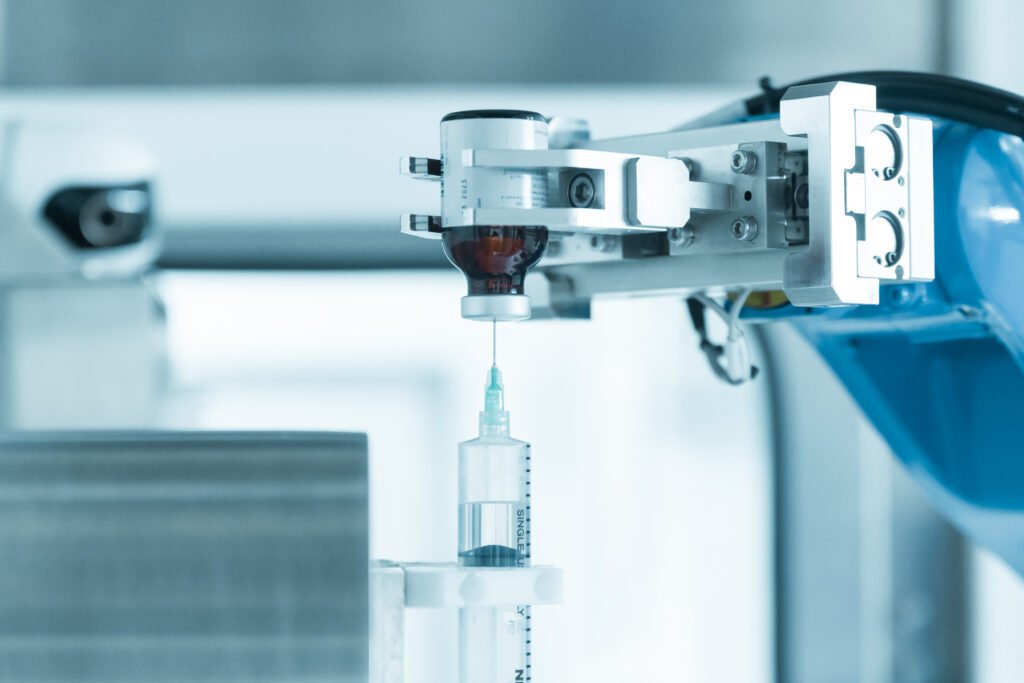
Our machine tending automation keeps your equipment running without breaks. A machine tending robot can load parts, unload finished products, and handle repeat jobs all day. From CNC robot tending to automated machine loading, we build systems that cut downtime, improve safety, and boost factory output—every shift.
What is Robotic Machine Tending?
A machine tending robot loads raw stock into a machine tool, pulls the finished part, and repeats that cycle for the length of the shift — that’s the whole job. A typical CNC tending sequence looks like this: the robot retrieves raw stock, orients or identifies the part, opens the machine door, removes the finished part, places it at an output location, loads the next blank into the chuck or fixture, confirms it’s seated, closes the door, and triggers cycle start. That sequence runs the same way on the 500th part as it did on the first — no missed loads from fatigue, no inconsistent hand placement, and no operator standing in front of an open spindle.
Applications of Automated Machine Tending (CNC, Molding, etc.)
Machine tending shows up anywhere a part gets loaded into and pulled out of a process, repeatedly, for hours at a stretch. The applications we see most:
CNC turning and milling – loading bar stock, castings, or blanks into a chuck or fixture and unloading finished parts to a conveyor, tray, or pallet
Injection molding and die casting – pulling parts from the mold or die, often with a sprue or runner removed before the part is staged for the next operation
Forging – transferring hot or heavy blanks between press stations where reach and thermal exposure limit manual handling
Grinding and deburring – presenting parts to a fixed process at a consistent angle and pressure, cycle after cycle
Washing and inspection – staging parts through a cleaning or vision check before palletizing
Palletizing – stacking finished parts into a pattern for the next operation or shipping
Each of these has different fixture tolerances, cycle times, and part-handling risks, so the robot, end-of-arm tooling, and machine interface get selected around the actual part — not a generic layout.
Benefits of Using Robots for Machine Tending
Robotic machine tending removes the operator from load/unload work and runs the same process every cycle. What that gets you:
More spindle-on time – the machine cuts instead of waiting on someone to clear or load a part
Faster non-machining time – a dual-gripper tool unloads the finished part and loads the next blank in one robot visit instead of two; a published CNC case study cut cycle time from 27 seconds to 15 seconds, a 44% reduction
Fewer missed loads and misloads – sensing at the gripper, fixture, and output location catches a bad pick before it causes a crash or scrap part
Operators out of the door swing – nobody reaches into a chuck or mold while it’s cycling
Predictable output – the same cycle runs on shift three as it did on shift one
None of this requires cutting headcount — it means skilled people aren’t standing at a machine feeding it by hand.
Our Machine Tending Integration Process & Capabilities
Every machine tending cell starts with the same question: what does the part actually need? We work through application discovery, collect part and machine data, and run a feasibility review before any hardware gets specified.
From there, the build follows a set sequence:
Robot and tooling selection based on payload, reach, repeatability, duty cycle, and environmental exposure — not just a payload number on a spec sheet
Risk assessment and safeguarding design per ISO 10218-1, ISO 10218-2, and ANSI/RIA R15.06
Mechanical and electrical design, including the machine interface signals — machine ready, cycle start, door status, chuck/vise status, part-present confirmation, alarm and E-stop coordination
Simulation or reach study to confirm cycle time and collision-free motion before we cut metal
Build, robot programming, and factory acceptance testing at our shop
Installation, site acceptance testing, operator training, and production handoff
A single-machine standard tending cell typically runs several weeks of engineering and fabrication; multi-machine or high-variant systems commonly run several months. Exact timelines come out of the quotation and design review, not a generic estimate.
The case for machine tending automation isn’t about robot cycle time alone — it’s about comparing current and proposed cycle time, spindle utilization, labor content, scrap and rework, changeover time, machine availability, and required operating hours side by side.
What that comparison usually shows:
More spindle-on time, less idle time between parts
Fewer scrap parts from inconsistent hand-loading
Safer cells — operators aren’t reaching into an active chuck or mold
Output that scales with additional shifts, not additional hires
Let’s Get Your Machines Working Smarter
If cycle time keeps slipping because nobody’s free to load the next part, that’s a machine tending problem, not a staffing problem. We can look at your part, your machine, and your production schedule and tell you straight whether robotic tending pencils out.
Ready to talk about your application? Let’s get started.
Talk A Robotics Integrator
We use your details only to answer your request, and we never sell or share your phone number. See our Privacy Policy and Terms of Service.
Success Stories: See What Business Have To Say About Robotics Integration
4.7 Customer Reviews
Working with Robotics Integration on our cobot implementation was exceptional. Their detailed training, expert guidance, and responsive support significantly enhanced our facility's safety and efficiency.
Jim R.Owner
Needed SCARA robots for assembly, and Robotics Integration quickly helped me find an RI in my area. The process was smooth, and our productivity skyrocketed—couldn't be happier!
Michael B.Operations Officer
Since integrating robotics, we've seen huge gains in throughput and cycle time reduction. Our OEE is up significantly, downtime is minimal, and labor utilization has never been better.
Hiro C.VP Operations
Business Satisfaction: 98% Delighted with Their Robotics Integration