Robotics Manufacturing & Process Automation

Tired of delays, labor shortages, and manual errors? We design and integrate manufacturing automation that works in real factory conditions. From CNC cells to full industrial automation systems, we deliver process automation solutions that boost output, reduce waste, and turn old processes into smart, scalable factory automation.

Overview of Manufacturing & Process Automation

Manufacturing and process automation isn’t about bolting a robot arm onto a line and hoping it works. It’s about matching the robot, tooling, and controls to the actual process—the cycle time, the part variation, the wrist load once you add a gripper and dress pack, and the reach needed to hit every pose in the cell.

Before we recommend a system, we run through a defined selection process: total wrist load including the workpiece, gripper, tooling, and dress pack; reach to every required position; mounting orientation; environmental rating; repeatability against your required tolerance; and controller or fieldbus compatibility with your existing line.

Applications we build cells around include machine tending, pick-and-place, palletizing, welding, dispensing, assembly, packaging, material removal, inspection, and part transfer. The robot’s spec sheet is a starting point, not the answer—the process determines what actually goes on the floor.

Robotics Manufacturing & Process Automation​

Key Robotics Applications in Manufacturing (Welding, Assembly, etc.)

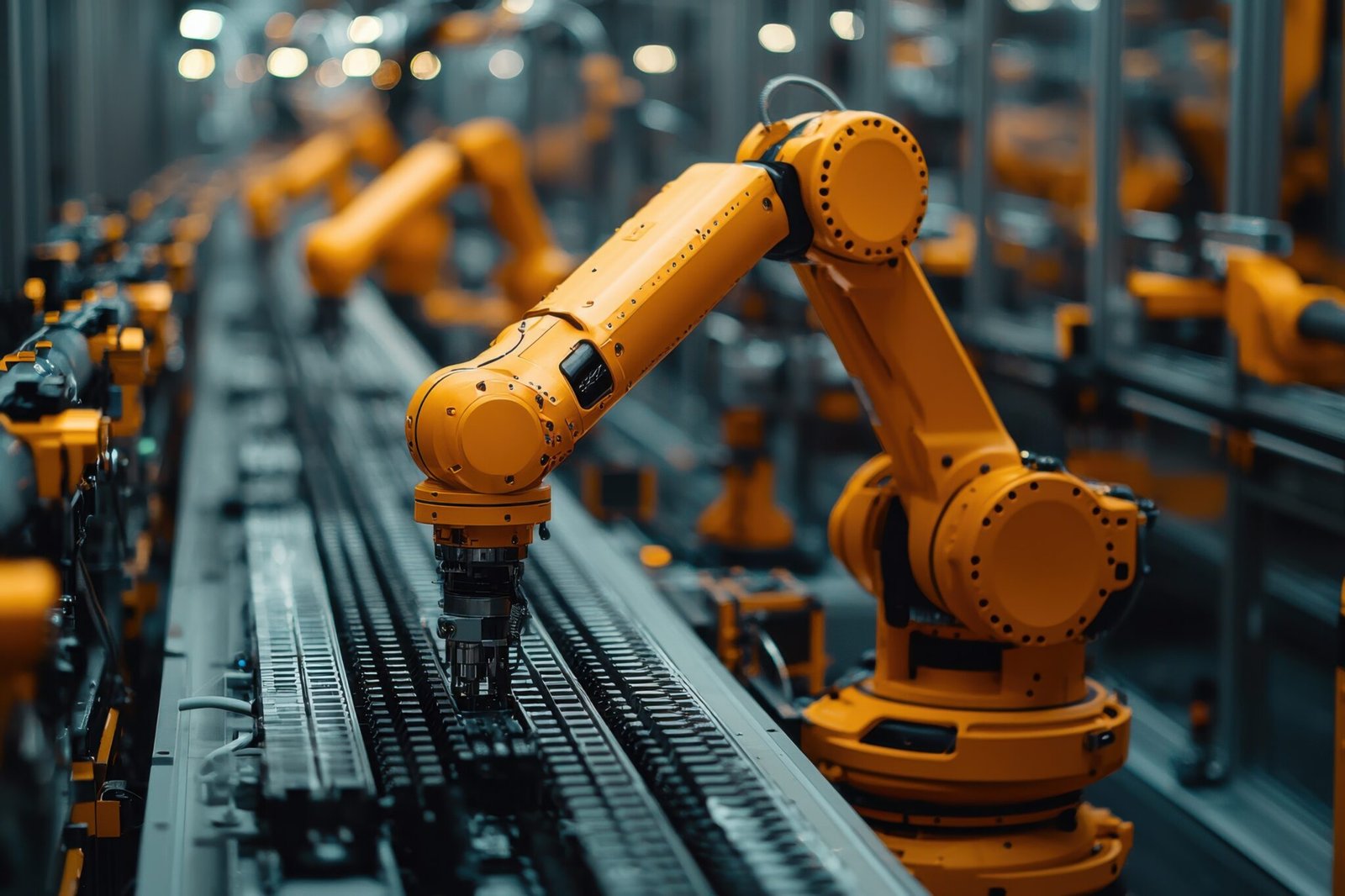
Not every job calls for the same robot. Delta robots—FANUC’s DR, M-1, M-2, and M-3 series, with payloads from 0.5 kg to 12 kg and reach from 280 mm to 1,600 mm—are built for high-speed picking of light parts. Six-axis articulated robots earn their keep where orientation matters: welding, dispensing, assembly around fixtures, or reaching into tight tooling.

For small-part handling, something like the FANUC LR Mate 200iD (7 kg payload, roughly 0.72 m reach) covers a lot of bench-level work without oversizing the cell.

Key Robotics Applications in Manufacturing

The applications below are common, but the robot, tooling, and sensing still have to be sized to your actual process, not just the label:

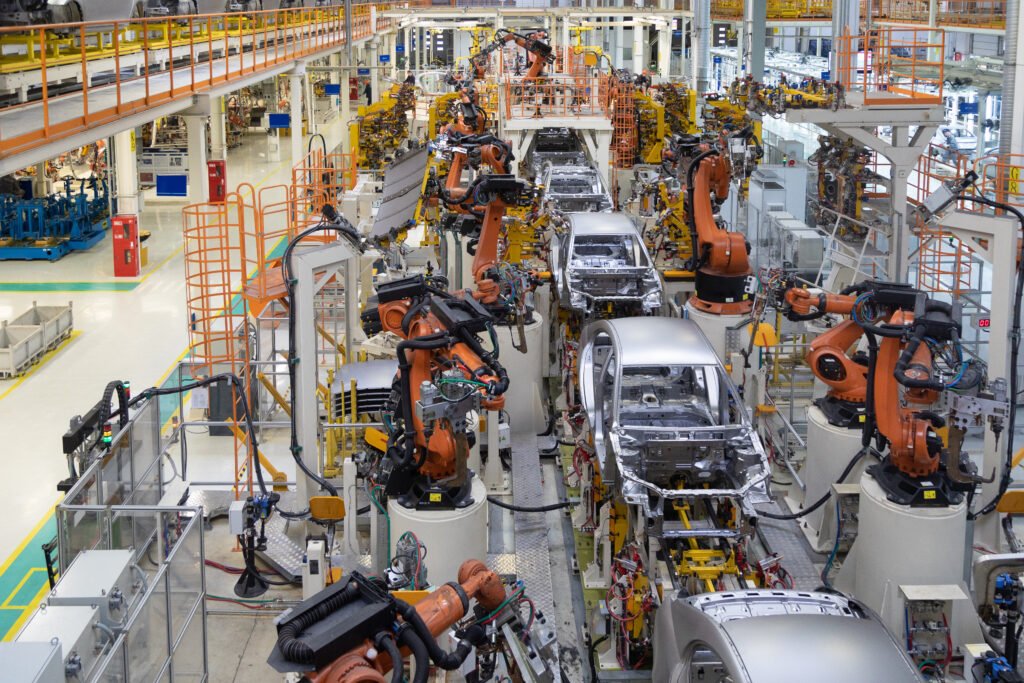
  • Welding Automation: A typical arc-welding cell pairs the robot with a welding power source, torch or gun, wire feeder, torch-cleaning station, fixture, part-present sensing, and weld-process monitoring, built around AWS D16 practices for robotic arc welding.

  • Assembly Automation: Mid-payload robots such as the FANUC M-20iD/25 (25 kg payload, 1,831 mm reach, ±0.02 mm repeatability) or the Yaskawa GP25 (25 kg, roughly 1,730 mm reach) handle most fastening and assembly work; IP65/IP67 variants exist for coolant or washdown environments.

  • Material Handling: Heavier jobs move to a class like the FANUC M-710iC/50 (50 kg payload, roughly 2.05 m reach), and palletizing heavy loads often calls for the R-2000iC family (165–270 kg payload, 2.65–3.1 m reach).

  • Surface Finishing and Deburring: End-of-arm tooling—deburring spindles, sanding heads, polishing tools—mounts to the robot flange per ISO 9409-1, so the interface is confirmed before tooling design starts.

Robotics Manufacturing & Process Automation​

Benefits of Robotics in Process Automation

Automation only pays off if you can measure it. We look at baseline versus target numbers—parts per hour, first-pass yield, scrap rate, changeover time, unplanned downtime, labor content, and mean time to recover—instead of vague claims about running “more efficiently.”

A well-built cell also changes what your operators do. Instead of manually loading fixtures or repeating the same motion for eight hours, they run quality checks, manage exceptions, and keep multiple machines fed. Repeatability numbers—like ±0.02 mm on a FANUC M-20iD/25—are useful, but repeatability isn’t the same as absolute accuracy; that also depends on calibration, fixture location, robot geometry, and part variation.

Safety is part of the value, not an afterthought. Every cell we design gets a documented risk assessment against ISO 10218 and, where collaborative operation is involved, ISO/TS 15066, with safety-rated control functions and validated emergency-stop provisions before it goes into production.

Add it up over a shift, a week, a quarter—the gains compound, and they show up in numbers you can defend to your plant manager.

Why Choose Robotics Integration?

We’ve run the sequence enough times to know where projects go sideways: undersized wrist-load calculations, skipped risk assessments, robots picked on payload alone without checking reach to every required pose or wrist moment. Our process—requirements capture, cycle-time study, robot and tooling selection, layout and risk assessment, offline simulation, build, programming, debug, safety validation, run-off, operator training, and production handoff—exists to catch those problems on paper instead of on your floor.

We work to ISO 10218 Parts 1 and 2, ANSI/RIA R15.06, and NFPA 79/UL 1740 where they apply to your equipment and jurisdiction. You don’t need to know the standard numbers. You need someone on the project who does.

Let’s Automate What Matters Most

Your process doesn’t need to be bigger—it needs fewer missed picks, fewer collision stops, and fewer hours lost to changeover. From a single machine-tending cell to a multi-robot line, we size the robot, tooling, and safeguarding to the actual job.

Tell us what’s slowing you down. We’ll tell you what it takes to fix it.

Talk A Robotics Integrator

We use your details only to answer your request, and we never sell or share your phone number. See our Privacy Policy and Terms of Service.

Success Stories: See What Business Have To Say About Robotics Integration

4.7 Customer Reviews
Industrial Automation Satisfaction: 97% of Clients Recommend Our Systems