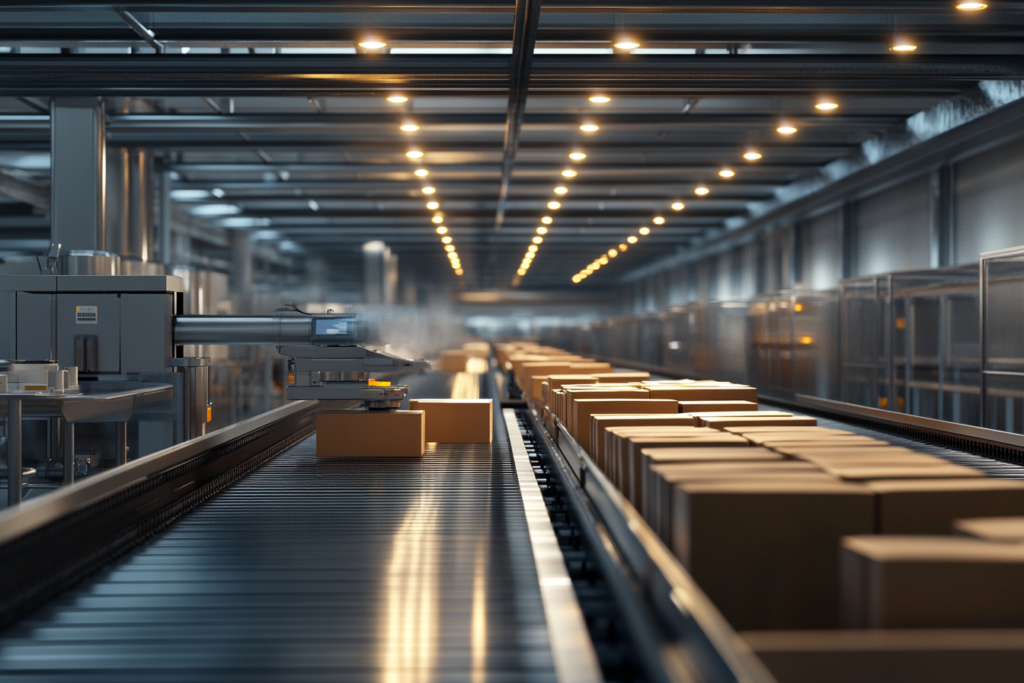
An automated packaging line succeeds or fails on the engineering behind it, not on which robot brand sits at the base of the cell. Pick-and-place units, case packers, palletizers, conveyors, sensors, safety circuits, and controls have to be designed and commissioned as one system, not bolted together after the fact. Payload gets calculated from the full load – product, gripper, adapter plate, cabling, and vacuum hardware – plus dynamic forces during acceleration, not just the item’s shipping weight. Undersize that number and you get overload alarms, reduced acceleration, or unstable motion once the line runs at production speed.
Get the cell right at the design stage and scaling to new SKUs or added shifts becomes a controls change, not a rebuild.
An automated packaging line is a sequence of pick, place, fill, seal, label, and stack operations, and each stage has its own tooling logic and its own way of failing.
Product Sorting and Orientation: High-speed pick-and-place typically runs on delta-style robots such as the ABB IRB 360 (1-8 kg payload, 1,130 or 1,600 mm reach) or FANUC’s M-3iA, guided by 2D vision for presence, position, and orientation. Reported rates run above 120 picks per minute in suitable applications, but actual throughput depends on product spacing and vision processing time as much as robot speed.
Filling and Dispensing: Dispensing cells need pump, valve, hose, nozzle, pressure, and material-compatibility selection matched to product viscosity and cure behavior. Fill or bead defects usually trace back to pressure instability, air entrainment, or nozzle wear rather than the robot path.
Sealing and Wrapping: Tooling has to be validated against film tension, crush strength, and allowable contact zones so the seal holds without deforming the product.
Labeling and Coding: Vision-guided systems, including Cognex In-Sight cameras, confirm label placement and barcode readability before product moves downstream. Glare, transparent film, and changing package artwork are the usual causes of intermittent misreads.
Palletizing and Case Packing: FANUC M-410iC systems are reported at up to 60 cases per minute for uniform case sizes; heavier-payload arms rated to 180 kg and 3,195 mm reach handle full pallet loads. Most palletizing faults trace back to case-dimension mismatches or bad pattern recipes, not the robot itself.
Explore E-commerce Automation Solutions, Print Workflow Automation Solutions, Robotic Palletizing Systems Integration, Robotic Packaging Integration Solutions and Robotic Material Handling Automation. See all Logistics & Packaging Robotics Integration Services solutions. Already running equipment? Our packaging robot service team keeps it running.
Robotic automation on a packaging line changes the economics of the operation, not just the look of it:
Throughput: A properly tuned cell holds its cycle time shift after shift; ABB’s IRB 260 is rated for up to 65 cycles per minute in packaging duty, and delta robots can exceed 120 picks per minute in the right application.
Lower Labor Cost: Repetitive picking, packing, and palletizing move off the headcount and onto the controls system.
Fewer Injuries: Repetitive lifting and pinch-point tasks move behind the guarding, to the robot side of the cell.
Consistent Placement: Repeatable tool paths cut case damage and mis-seals compared with manual handling.
Changeover Flexibility: Recipe-driven programs let one cell run multiple SKUs without a hardware rebuild.
Some industries get more out of a packaging robot than others, mostly because of what the product and the regulatory environment demand:
Food and Beverage: Washdown duty calls for IP-rated arms – FANUC’s M-10iD/12 food-grade configuration (12 kg payload, 1,441 mm reach, IP67) is a common choice for wet, corrosive environments.
Pharmaceutical: Traceability, recipe control, reject containment, and validated changeover matter more here than in a typical secondary-packaging line.
Consumer Goods and Chemicals: Mixed-SKU packing and container handling; one reported paint-line installation used robots to handle one-quart, one-gallon, and five-gallon containers off three filling lines and to pick empty pallets.
E-commerce and Fulfillment: Variable box sizes and high pick counts drive vision-guided sortation and case packing.
Automotive and Electronics: Multi-part kitting and case packing benefit from tool-changer flexibility across product variants.
Picking an integrator for a packaging line comes down to what they can prove, not what they promise:
Documented Process: Ask for a cycle-time and reach study, a risk assessment, and written FAT/SAT procedures – not a verbal estimate.
Safety Competence: Familiarity with ISO 10218-1/2, RIA R15.06, and ANSI B11 should show up in the design, not just the proposal.
Controls Depth: PLC handshaking, product tracking, recipe selection, and fault recovery need to be planned upfront, not patched in after startup.
Service Coverage: Spare-parts availability, remote diagnostics, and a clear change-order process matter once the line is running production.
We build proposals around those points, then commission the cell against them.
We use your details only to answer your request, and we never sell or share your phone number. See our Privacy Policy and Terms of Service.
+1 602-449-1556
602-449-1556