
We use your details only to answer your request, and we never sell or share your phone number. See our Privacy Policy and Terms of Service.

Fund your robotics integration through measurable operational improvements—turning your savings directly into repayment, with no heavy initial investments.










+1 602-449-1556
+1 602-449-1556
hello@roboticsintegration.com
We use your details only to answer your request, and we never sell or share your phone number. See our Privacy Policy and Terms of Service.
The Los Angeles Basin manufacturing sector employs more than 420,000 workers across all educational-attainment levels. The three largest subsectors are computer and electronic product manufacturing, fabricated metal product manufacturing, and transportation equipment manufacturing, together accounting for about 40% of manufacturing employment. Aerospace manufacturing, electronic-instrument manufacturing, and semiconductor and electronic-component manufacturing are also major employer industries in the region.
Los Angeles-area manufacturing combines high-tech and low-tech production. Manufacturing jobs in the Los Angeles Basin pay average wages higher than the combined average for all industries in the basin, reflecting the mix of precision electronics, metal fabrication, and transportation and aerospace production found across the metro.
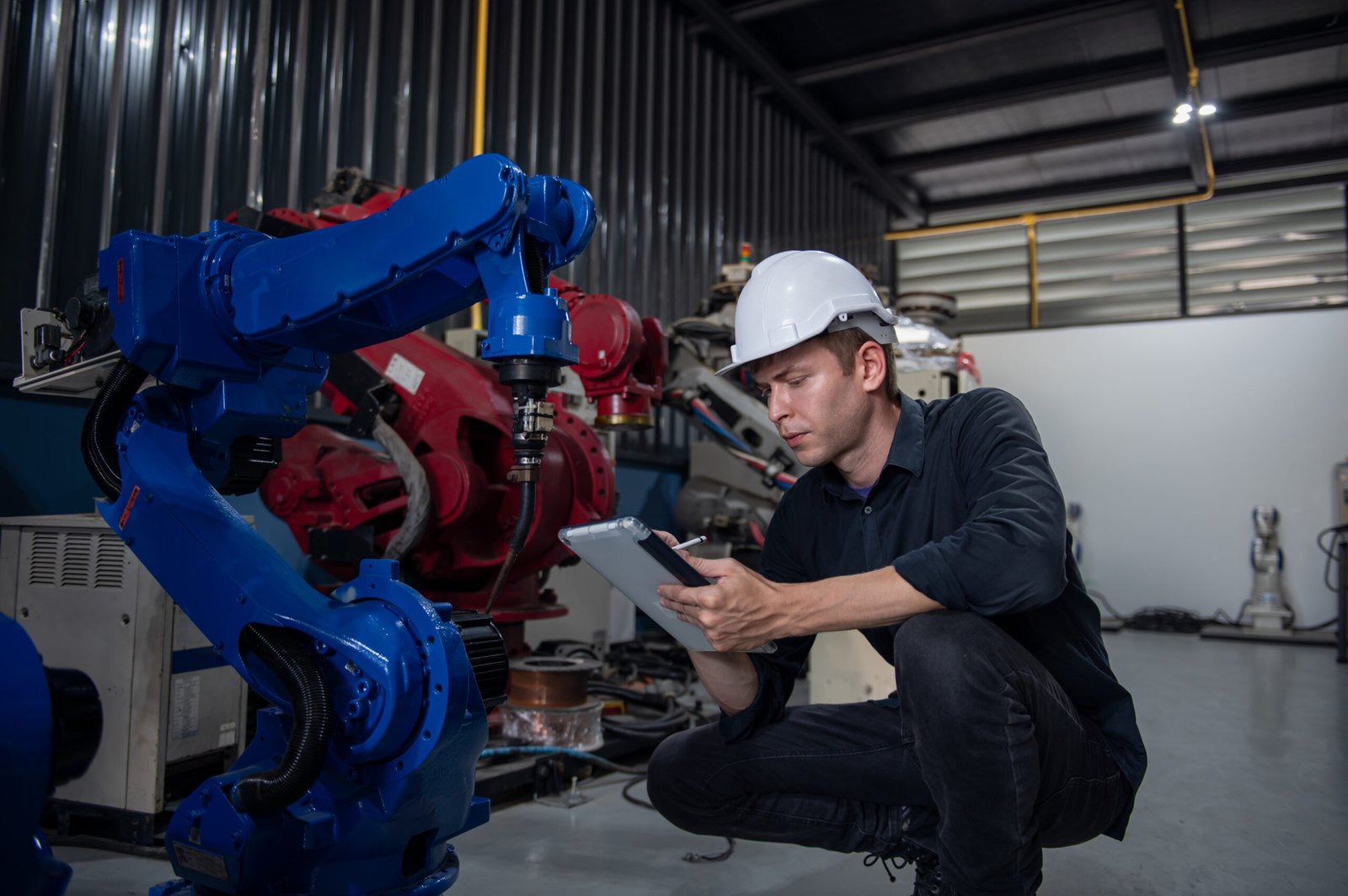
Computer and electronics manufacturers in the region can apply robotics to machine tending, assembly, inspection, and material handling, work suited to compact six-axis arms and light payload classes on tight production lines.
Fabricated-metal manufacturers can use robotic welding, cutting, grinding, deburring, machine tending, and inspection, typically with mid-payload arms paired with fixturing built for repeat part families.
Transportation-equipment and aerospace manufacturers can use robotic welding, fastening, dispensing, composite layup, machine tending, inspection, and material handling. These tasks often call for higher-payload arms, longer reach, and tooling built around large or irregular parts common in aerospace and vehicle production.
California runs an OSHA-approved State Plan, Cal/OSHA, which covers private-sector employers instead of federal OSHA. Any robotics installation or repair project in Los Angeles should be scoped against Cal/OSHA requirements alongside ISO 10218 and RIA R15.06 guidance for industrial robot safety, including risk assessment, guarding, and safeguarding of the human-robot workspace.
State-level funding can offset project costs. The California Competes Tax Credit is a state income-tax credit for qualified businesses. The Employment Training Panel reimburses training costs, with awards up to $600,000, or $850,000 for certain customized-training projects. California also lists business and workforce-development grants, with maximum awards ranging from $10,000 to $3 million depending on the solicitation, and a new-employment tax credit for qualifying semiconductor, electric-airplane, lithium-production, and lithium-battery manufacturers. The High Road Training Partnerships program has funded manufacturing training statewide, reporting 32,000 workers trained since 2019, with an $18.6 million round in 2025 supporting at least 4,600 additional Californians.
Before an assessment, gather cycle-time data, part drawings or CAD files, current floor-space dimensions, and available utilities including power, air, and network drops. This lets an integrator size the robot, payload class, and safety envelope against real production constraints rather than estimates.
Local training pipelines can support staffing once a cell is running. Los Angeles Valley College offers coursework in robotics and programmable logic controllers. Los Angeles City College offers a Robotics Technician training course. Los Angeles Pierce College offers an Engineering Design and Technology associate degree, and four-year options include mechanical engineering at UCLA and mechatronics engineering at California State University Channel Islands. The Los Angeles Small Business Development Center also points manufacturers toward California Manufacturing Technology Consulting and Long Beach Community College District workforce programs for Industry 4.0 adoption support.
Typical project phases include an initial assessment, a design and simulation stage, installation and integration, safety validation against Cal/OSHA and applicable robot-safety standards, and operator or maintenance training before full production handoff.
We also serve Robotics Integration in San Diego, Robotics Integration in Phoenix, Robotics Integration in Seattle, Robotics Integration in San Francisco and Robotics Integration in San Jose — or browse all service areas.

602-449-1556


