
CNC and Machine Tool Spindle Repair
Signs Your CNC Spindle Is Failing
Spindle failures rarely start suddenly. Operators typically notice new noise at speed, heightened vibration, heat at the nose or housing, chatter or poor surface finish, and runout that shows up as tool marks or dimensional drift. On FANUC-controlled machines, the spindle amplifier displays a two-digit alarm code on its status indicator that points to the fault area.
- Alarm 01 – motor overheat; check the thermostat/temperature circuit, cooling fan, cooler cleanliness, overload, and connections
- Alarm 02 – excessive speed deviation; check for overload, damaged power devices, poor connections, or feedback faults
- Alarm 03 – blown DC-link fuse; inspect the power transistor section before replacing the fuse
- Alarm 06/07 – overspeed or temperature-sensor disconnection depending on amplifier series; verify against the specific manual
- Alarm 12 – excessive DC-link current; check motor leads, insulation to ground, motor parameters, and IGBT/IPM condition
- Alarm 749/750 – serial spindle communication or link-start failure; check cable/fiber connections and cabinet grounding
Any of these symptoms or codes on a Haas, Mazak, Okuma, HSD, Fischer, GMN, or Setco spindle warrant inspection before continued production.
How Spindle Repair and Rebuild Works
A spindle rebuild starts with intake and electrical testing, not disassembly. We record the full nameplate, motor or amplifier part number, machine model, control type, alarm history, commanded versus actual speed, cutting load, cooling method, and when the fault occurs – at startup, during acceleration, or under load. That data drives the rest of the scope.
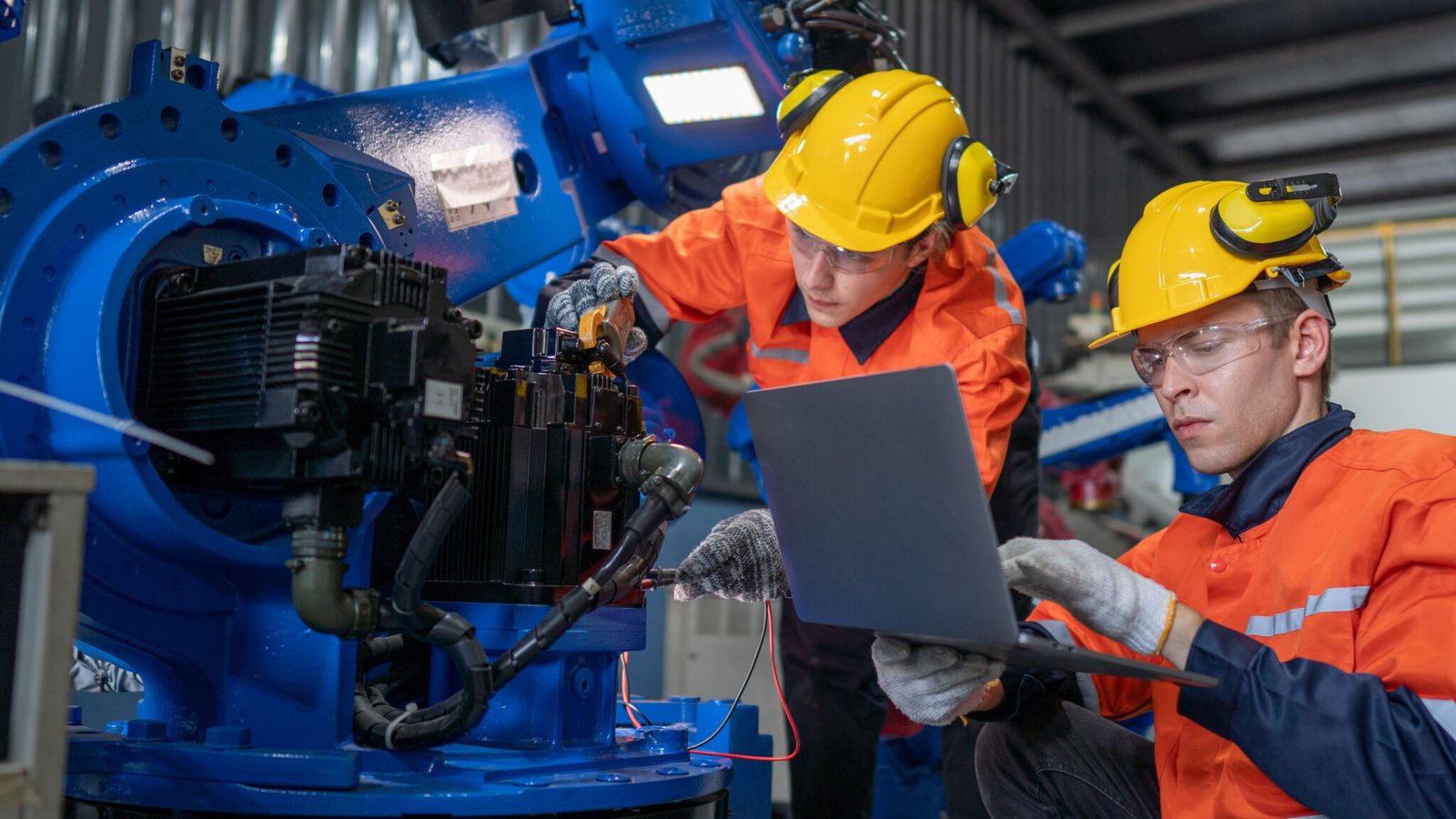
Work proceeds through disassembly, cleaning, dimensional inspection, bearing and seal evaluation, runout checks, and encoder or sensor inspection. Motorized/electro-spindle rotors and windings are checked separately from bearings and drivetrain, since heat and vibration can originate in either. Belt-driven units get belt condition, tension, and pulley alignment checks; gear-driven units get tooth condition, backlash, and lubrication checks; router spindles get collet/taper condition, rotor balance, and high-frequency drive compatibility checks.
Models and part families we repair
- FANUC A06B-6062 spindle amplifiers, including -H206, -H208, -H212, -H215, and -H222
- FANUC A06B-6064 spindle amplifier family and matched spindle motors
- Haas spindle motors and belt/gear-driven spindle cartridges
- Mazak and Okuma motorized and gear-driven machine tool spindles
- HSD and Fischer electro-spindles for routing and machining centers
- GMN and Setco precision spindle cartridges and bearing packages
Testing and Verification Before Return to Service
Before a spindle ships back, it goes through bench and functional testing to confirm the failure was actually corrected. Insulation resistance and phase resistance/balance are measured, encoder or sensor signals are verified, and shaft runout and bearing noise are checked at rest and at speed. Rotation direction and speed regulation are confirmed against the commanded signal.
A load test applies controlled acceleration, checks at operating speed, and representative torque or power loading while current, vibration, temperature, speed feedback, and alarm behavior are recorded. Where a dyno is used, it applies a controlled opposing load to verify torque, speed regulation, current draw, and thermal behavior across the spindle’s rated operating range. A burn-in run follows to expose infant failures and confirm stable temperature, vibration, lubrication, and feedback behavior over a documented run period.
Final test records preserve as-found condition, replaced parts, bearing data, measured runout, insulation results, speed and load data, temperature rise, vibration readings, alarms observed, and the final parameter configuration.
Preventing Spindle Failures
Most spindle failures trace back to bearing fatigue, lubricant degradation, contamination, coolant ingress, interrupted cooling, rotor imbalance, tool-interface damage, encoder failure, or drive-power-device failure. Several of these are preventable with routine attention.
Maintain the cooling flow and temperature specified by the manufacturer, keep air or liquid cooling paths clean, and check fans and filters on a schedule. Inspect coolant lines for leaks and avoid directing coolant at a hot, stopped spindle unless the design provides adequate sealing – thermal shock and coolant ingress are common causes of bearing and motor damage.
Lubricate strictly to the spindle manufacturer’s specified grease or oil, quantity, interval, and delivery method; mixing greases or overpacking bearings raises operating temperature and shortens bearing life. Use balanced tool holders, correct collet condition, clean tapers, and proper drawbar force to reduce radial, axial, and shock loading. Track vibration and temperature trends and investigate new noise early – by the time an alarm appears, damage is often already underway.
Repair Versus Replacement Benefits
A spindle that is down stops the machine, not just one component, so the practical question is usually repair time versus replacement time and cost. New OEM spindle motors and amplifiers are available, but lead times vary by model, and older controls or spindle modules can be affected by discontinued electronics, obsolete feedback devices, or unavailable parameter data.
Repair or rebuild of the existing unit, exchange for a rebuilt equivalent, and new OEM replacement are three distinct paths with different cost and lead-time profiles; a quotation should state which path applies to the unit in hand and note any exclusions for crash damage, missing nameplates, undocumented modifications, or damage found after disassembly. Lead time depends on inspection queue, parts availability, bearing and encoder procurement, and test-fixture capacity – it is not the same for every unit, which is why an accurate quote requires the actual nameplate and fault data rather than a general estimate.
Why Choose Robotics Integration for Spindle Repair
Robotics Integration works across FANUC, Haas, Mazak, Okuma, HSD, Fischer, GMN, and Setco spindle constructions, from motorized/electro-spindles to belt- and gear-driven machine tool spindles and router spindles, along with the spindle amplifiers and drives that control them. Because alarm meanings, connectors, feedback systems, and replacement parts vary by series, even within one brand, identification against the exact nameplate and control configuration comes before any diagnosis or quote.
Support is available as repair-and-return on the spindle, motor, or amplifier, or as on-site diagnostic and troubleshooting support when the unit needs to be evaluated in place before removal. Quoting starts with the information described below: full nameplate data, symptoms or alarm codes, and machine context. From there the unit is assessed as repairable, exchange-eligible, or requiring new OEM sourcing, and the quote states which category applies along with any exclusions found during inspection.
Request a Spindle Repair Quote
To get a spindle repair quote, send the complete spindle or amplifier nameplate, motor or part number, machine make and model, control type, and a description of the symptoms or the exact alarm code displayed. Photos of the nameplate, the mounting condition, and any visible damage help narrow the diagnosis before the unit is removed or shipped.
Also note when the fault occurs – at startup, during acceleration, or under load – and whether the machine is currently running, alarmed out, or fully down. That detail, combined with the nameplate and part number, is what makes a repair, exchange, or new-unit quote accurate rather than a rough guess.
Call 1-602-449-1556 to discuss a FANUC spindle motor, a CNC router spindle, or any belt-, gear-, or motor-driven machine tool spindle that is down or showing early warning signs.
Talk A Robotics Integrator
By submitting this form, you agree to receive communications via phone, text message, and email. Message and data rates may apply. Your information may be shared with trusted third-party service providers solely for the purpose of helping you explore Section Robotic Intergration options. You also agree to our Privacy Policy and Terms of Service.
+1 602-449-1556
Success Stories: See What Business Have To Say About Robotics Integration
4.7 Customer Reviews